



As compliance rules in Hong Kong get trickier, a lot of employers are wondering the same thing: Should we invest in a human resource management system, or is it smarter to just outsource our HR?
Both options promise to save time and cut down on busywork. But when it comes to payroll, MPF compliance, and tax filing, the real issue is risk—and who’s actually on the hook if something goes wrong.
Let’s break down HRMS vs. HR outsourcing for Hong Kong businesses. Whether you’re local or new to the market, you’ll want to know the real differences around cost, accountability, and compliance risk.
Why Hong Kong Companies Weigh HRMS vs. HR Outsourcing
The HR compliance scene here covers a lot:
- Meeting the Employment Ordinance
- Calculating and paying MPF on time
- Handling IR56 tax reporting
- Keeping payroll records straight
One mistake can do more than slow things down—it can trigger fines, audits, and damage your reputation fast. That’s why more companies are asking if an HRMS alone is really enough.
What Exactly Is an HRMS?
A human resource management system, or HRMS, is just software that handles HR data and tasks.
The basics it usually covers in Hong Kong:
- Employee records
- Payroll calculations
- Leave and attendance tracking
- Basic compliance reports
HRMS vs. HRIS—Are They Different?
In practice, people use these terms for pretty much the same thing. Both are about automating processes, not taking legal responsibility for mistakes.
Important: An HRMS helps you process information, but it won’t shoulder the blame if something goes wrong.
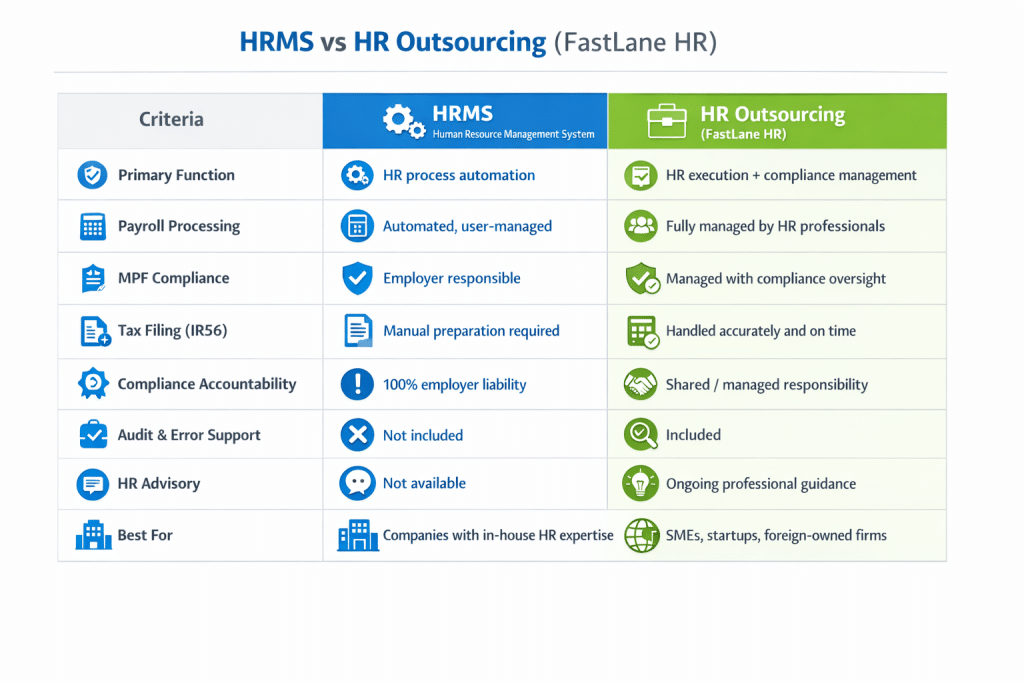
Comparison Table 1: HRMS vs HR Outsourcing in Hong Kong (At-a-Glance)
What Does HR Outsourcing Mean in Hong Kong?
Outsourcing HR means handing off your HR tasks to pros who deal with the details and make sure you stay compliant.
What HR Outsourcing Usually Covers:
- Payroll processing
- MPF enrolment and reporting
- Tax filings like IR56 forms
- HR paperwork and advice
Who’s Actually Using HR Outsourcing?
- SMEs without their own HR staff
- Startups hiring their first team
- Overseas companies who aren’t up to speed on local rules
HRMS vs. HR Outsourcing: A Head-to-Head Look
Cost Efficiency: Software Fees vs. Service Fees
- HRMS: You pay subscription fees and spend your team’s time
- HR Outsourcing: Fixed service fees, less time spent in-house
Be careful—HRMS users often end up facing extra costs when they have to fix compliance mistakes themselves.
Compliance Accountability: Who’s Actually Responsible?
- HRMS: The employer holds all the legal risk
- HR Outsourcing: Responsibility is shared or managed, depending on your agreement
This really matters when you’re facing an audit or a dispute.
Accuracy & Risk Exposure
- HRMS depends on how accurately you enter data
- Outsourcing brings in professional checks and advice
Not sure where your compliance risk stands? FastLane HR can help you figure out whether HRMS, outsourcing, or a mix of both actually protects your business.
Payroll, MPF & Tax Compliance: Where HRMS Comes Up Short
Common Payroll & MPF Errors with HRMS:
- Wrong contribution calculations
- Late MPF payments
- Employees misclassified
Tax Gaps HRMS Can’t Close:
- Preparing IR56B/F/M forms
- Year-end employer reports
- Audit support
Bottom line: Software can crunch numbers, but it can’t interpret the rules or back you up when there’s a challenge.
When Does an HRMS Make Sense in Hong Kong?
It works best when you have:
- A steady team
- HR experts in-house
- Simple, low-risk compliance needs
But here’s what people often miss:
- compliance advice
- buffer if something goes wrong
- No one to stand up for you during audits
When HR Outsourcing Makes More Sense
You’ll want to outsource when you’re:
- hiring your first employee
- growing or expanding
- a foreign-owned business
- Payroll changes a lot
Mistakes can get expensive fast. One penalty or audit can easily cost more than a year of outsourcing fees.
The Hybrid Model: Mixing HRMS and HR Outsourcing (FastLane HR Style)
A lot of Hong Kong companies use a hybrid approach:
- HRMS for keeping tabs on your staff and records internally
- FastLane HR for handling payroll, MPF, and tax compliance
You get the best of both worlds—efficiency and real accountability.
FastLane HR connects with your HRMS, takes care of payroll, MPF, and tax compliance, and makes sure nothing slips through the cracks.
How to Choose: HRMS or HR Outsourcing?
Ask yourself:
- Do we really know HR compliance inside and out?
- Who fixes payroll errors or deals with audits?
- Are we on top of MPF and tax deadlines?
If there’s any doubt about responsibility, outsourcing cuts your risk.
Quick Q&A
No. HRMS helps automate tasks, but you still carry the legal risk.
Not if you factor in the cost of mistakes, penalties, or the time your team spends fixing things.
You are, even if you use an HRMS.
Absolutely. In fact, it’s often the safest way to stay compliant.
Conclusion
You can use both HRMS and HR outsourcing. A lot of companies do this—they run their HRMS, but let FastLane HR handle the nuts and bolts of compliance.
So which one’s better: system or service? Honestly, it depends on what you want. HRMS makes your workflow smoother and faster. Outsourcing, though, takes a load off your shoulders when it comes to risk.
At the end of the day, it’s not really about price. It’s about who’s actually responsible for keeping you compliant.
Want to figure out what works for your business? Reach out to FastLane HR. They’ll help you decide if HRMS, outsourcing, or a mix of both will keep your payroll, MPF, and tax compliance on track.